Among other, much more important things (like story, characters, dialog, etc.), one of the things that really bugged me about Star Trek Picard is how the show uses holographic interfaces. In short, it’s bad. Like, really bad. I know what they were going for: “This isn’t your daddy’s Star Trek; this is the future now.” (Implicit in the statement is that it isn’t for Daddy, ie the people that actually are Star Trek fans (the average age for Trek conventions is…not as young as anime conventions, to put it gently), but that’s besides the point.)
Now, not everything they do with holograms on the show is bad – just most of it. There is absolutely nothing wrong with having Picard’s room on the ship, where they had the “conference” scenes in the first part of the show, be a holographic recreation of his office on Earth (and the fact that it lets the show reuse the set is a bonus). The whole point of the holodecks in the show was that you could do that kind of stuff. Heck, they could have had the whole bridge be a holographic bridge. Probably should have done that, actually, instead of what they did (and they should have kept using Picard’s room for conferences later, instead of the park tables of later episodes). The bridge set was already pretty similar to Voyager’s or DS9’s holodeck sets; I kinda expected them to go that route, at first (especially since they already have a holographic crew…).
No, where they go wrong is everything else. Look at that. Looks cool, right? Well, it’d suck to actually use it. Look how dim it is. Compare that to, say, Mass Effect:
Easy comparison to make.
A proper interface would be easy to see. In STP everything would be hard to see. In ME the interface is bright, easy to see. And it’s got a dark background, while STP has whatever is behind the hologram, every time. Which is usually something not much darker than the hologram itself. How are you supposed to read anything like that? There’s a reason ereaders and phones these days have high-contrast modes.
Also, specific to the interface used for piloting the ship, that interface tracks head movements. But you’ll notice that it’s a lot larger than a human’s field of vision, let alone the useful field of vision. Remember, the useful field of vision for anything like this is only a few degrees, not even five. If what you’re looking at is only a little bigger than that (like a single computer screen), you only have to move your eyeballs, but if it’s as big as Picard’s interface up there, you have to move your head. Not a huge problem…unless it tracks with head movements. This is shown multiple times in the show (including that above scene) – this would be supremely annoying to use. And of course the center part is completely empty of information, despite the fact that that’s exactly where you’d want to put the most important stuff.
A hologram inside a hologram…
Of course, the reason this was done was purely because it “looks cool”. Sure, the interface makes absolutely no sense from an actual human perspective. But you don’t need “tacky” flat screens, no touch screens that need to be on-set. You can just film the actors waving their hands around, poking at the air, and then try to make what they do make sense in post. It’s yet another example of modern Trek (and Hollywood in general) not thinking things through, but merely doing what is cool and easy.
This is going to be really short, because I don’t have the time or energy for a full review (which is coming, to be sure), nor the screenshots I thought I had. But, to be quick about it:
This show sucks. Like, seriously, it sucks.
At first I thought it wasn’t too bad. And it wasn’t. Just a bit slow, and nonsensical. But still watchable. But then it got worse.
It was never Star Trek, really. Sure, it had some characters that were in Star Trek, in the past. But the show itself is just some random sci-fi show that they slapped a Trek skin on.
And it’s not even a good random sci-fi show. The plot is so full of holes, it makes swiss cheese envious. The dialog was generally very bad, especially as the show went on. The editing isn’t very good. The effects are passable, barely, and don’t even feel Trek-like. Everything is anachronistic.
For some reason Screen Rant has a list of the ten best Star Trek games. Now, I haven’t played all of these, and have played some others, but there are a couple of things I wanted to say, which I didn’t think merited making a comment on their site.
First, they have Star Trek: Timelines on the list. The fact that this prime example of a mobile kusoge is better than any game out there, let alone Judgement Rites, is a disgrace to all people with brains. The “game” is 95% comparing the stats on your unit with the required stats + rng of some situation: basically a whole game of saving rolls in a RPG. Except without the story or fun. That last 5% is an actual game that involves space combat and making a decision or two. A simple game, which isn’t presented particularly well, but it is at least a better game than nakedly rolling dice against a table. All in the service of its gacha, of course. I’m sure that the other major Trek mobile game, the one set in the Kelvinverse, is better than that garbage.
The next thing is that they have STO as the best Trek game of all time. I’m not so sure of that being true – but I’m not sure it isn’t true, either. If it was just a spaceship game, Starfleet Command (any version) beats it, hands down. (Heck, STO space combat is just a simplified version of Starfleet Command.) And just about any competent game beats it on the ground game (STO is competent too, but just barely). And as a story, it’s not exactly that great either (though, again, competent – which is good enough for me in this area). But I don’t think there’s any game that brings it all together like this. STO is definitely more than the sum of its parts. Thinking on it, while I don’t think STO deserves the title of “Best Star Trek Game of All Time,” I can’t think of another game that does, either.
Just a quick update, since I’m not dead. January gaming was just basically ESO, with dailies in Dragalia Lost and playing the events in STO and Granblue Fantasy. Made a new character in ESO (2H/S+B Nightblade Tank), kinda on a whim (since some bloggers I knew were talking about how ESO’s combat was kinda not satisfying, which wasn’t my experience – but I’ve only played ranged until now, which has a completely different feel than melee; so I wanted to see what was up with that). So yah, that’s what’s up there.
In terms of “posts I’ve been meaning to do but haven’t because REASONS,” I have watched the last two episodes of Picard. The second episode was somewhat better than the first, but the third was the worst so far. Long story short, I just don’t care about the characters or the world that’s been set up. I’ll keep watching for now, since this is the end of the pilot, so to speak; or the first area of an RPG. But it’s been almost 1/3 of the season (3/10 episodes). This wasn’t necessary, and everything could have been done in one episode, maybe 1.5. And it would have made me happier, since a lot of the stuff that annoyed me could have been cut without any repercussions to the overall story. Not all the annoying stuff, but most of it.
I’ll have another post tomorrow about Love Your Backlog Week – but I need to get my backlog organized! (Hopefully GOG’s unification of my stuff will help.)
To put it right at the front: I didn’t like it. I’m going to put a short version of my review that I’ve placed elsewhere (I believe in recycling!), then go into more detail:
In short, if you’re looking for a generic sci-fi show, this isn’t too bad. Not good either, but not terrible. 4/10, mostly brought down from the apparent need to have absolutely minimalist dialog to get to the next scene (like a second-year writing student heard for the first time “brevity is the soul of wit,” and applied that to almost every single scene). Most of the sjw propaganda isn’t too much on display at this point. The apparent Mary Sue co-protagonist at least has a reason for being a sooper-speshal butt-kicking waif. I’m thinking most of the stuff from the trailer is going to be in the next episode.
As a Trek show, it’s pretty bad. Not STD bad, but still bad. Even the worst episodes of proper Trek gave you time to think about whatever thing was on offer. Even if what they were describing was dumb, they at least gave time to try to give an explanation, not just expecting the audience to hear some thing and just accept it, before instantly moving on. And, continuing the JarJarTrek pattern that’s been going on the last decade, it’s like the people that wrote this only knew about Trek from memes and scanning Memory Alpha articles – and I include Patrick Stewart in this (apparently, he’d never even watched his own show until a couple years ago). There’s a whole memberberry vault too (though, fortunately it’s kept mainly to the one scene). I never got the feeling that Data was Picard’s BFF (I’d say that he was closest to Worf, of anyone besides Crusher), but apparently that’s the case, and it’s the thrust of the plot, even though that was 20+ years before the events of the show.
But, at least it completely invalidates the idiots that thought a comic was canon. That’s nice.
Yes, I know this is about the haters, but I filled it in about the episode itself.
Data doesn’t look too bad, but still weird. It’s obviously a dream, so that’s fine.
Weird editing all around. Like, bad enough that even a know-nothing non-kinophile like me can notice.
Credits are dumb and boring.
Holy crap, could the scene with the boyfriend be any more [Current Year]? This would literally fit in any CW drama. The only thing that makes it sci-fi at all is the fact that the guy is an ayy lmao. (And I guess he mentions the replicator.) A cringeworthy CW drama to boot. So awkward.
Ah, and Dadge/Dajh/whatever (it’s Doge now) is now a fellow at Daystrom in TWO fields! So smart and STEM! Slay queen! I like science!
No Russian Speak English! I guess it makes sense that not everyone on Earth would necessarily have universal translators. And the alien who might have had one is dead, so his probably turned off, if he had one.
Let’s not knock her out, or beam her up, or whatever, now that we know that she’s safe to handle. No, let’s put her in more conscious danger by putting a bag over her head (wouldn’t want her to know the transporter path back to our hidden base/ship)!
Are the Romulan couple refugees themselves? I think that’s supposed to be the implication. Are they random people that Picard invited to live with him? Are they specifically hired as caretakers (doing job no Earthman would do)?
“They said they wouldn’t ask about [thing].” They’re definitely going to ask about [thing].
The interview is the exposition dump. This is literally the only thing that explains what happened between Nemesis and this show. Very awkward and jarring.
Why did they have that light and camera setup? Even in Enterprise they had cameras and lights that the reporter could just wear on their face.
“Romulan lives.” “No, LIVES.” Wow, so powerful!
I’m not going to hate on the 900M people thing. I figure that the Romulans were using their own ships (and maybe the other powers helping out) in the lead-up to all that. I mean, if Picard thought he had time to build 10,000 ships, there was obviously a lot of warning. Enough time to evacuate billions, probably. Just the unlucky plebs that got left behind.
Why is this a huge (potential) refugee crisis, for the Federation? It’s the Romulan STAR EMPIRE. They have other planets.
The whole “Synths did it, so we’ll outlaw synths and also turn insular and not help out” was really forced. Not only is it not TNG-era Federation/Starfleet AT ALL, but it just doesn’t make sense. At least with the Augment thing there’s reason, however dubious. This is just for setting up a fake moral dilemma to set up the plot the creators wanted (particularly Stewart).
At least they got one thing right: Picard wouldn’t shoo away some crazy girl that shows up at his house uninvited, at least not without listening to her story. Even considering her story, he’s seen much weirder stuff.
PLEASE PAY ATTENTION TO THE NECKLACE. I mean, talking about it would be a good way to calm someone down in a crisis (and Picard is good at that), but it’s so bloody obvious that this pretty boring and normal necklace is going to come up later for some reason.
OK, the first dream sequence was fine. But now Picard is having prophetic dreams.
I like how it’s morning in France, and late-night in Boston. At least someone writing this had a brain.
For some reason Picard uses the Starfleet Archives as his safety deposit vault. And for some reason he keeps his ship models and sword there. It’s obviously supposed to be some kind of display area, but for some other reason only Picard is allowed in it. And why does the computer take more than an instant to search out his very simple queries?
It says Quantum, so you know it’s advanced! I like science!
So she’s a synth, and she’s tied to Data somehow (and now has superpowers), so naturally that must mean she’s Data’s daughter. Which he always wanted.
Why not just carry the old man, since you have super powers?
Why are you running to the roof, where it would be very hard to escape from?
How does she know “they” are coming? It seems like she can hear them, but then they beam in, which means they were on a ship.
So is she a proper robutt, just human on the outside (like the Borg were doing to Data in First Contact)? Because then her superpowers would make sense. But the Daystrom lady and Picard make it seem like she is basically in effect an augment; while they are strong and smart and whatever, they weren’t Avengers.
A 91-year-old man (who could barely get up the stairs, so he isn’t some future-science fit dude) was thrown 40 feet by an explosion, and all he got was a bump on the head. Lucky!
The entire Daystrom scene was bad. Dialog and pacing were terrible, the worst example of what I was talking about up at top.
Why do they come in pairs? This isn’t a mystery box thing. Real Trek would have at least given a cursory explanation (and Voyager a long-winded, terrible, technobabble explanation) for all of this mess.
Good thing she has a twin, so we don’t lose our Mary Sue protagonist.
Oh look, ROMANCE!
Also, Borg Cube. If I hadn’t played STO for years, this would have been a negative; but Romulans playing with Borg stuff is a plot point in the game, so I’m used to it.
Not a promising start. It could get worse or better from here, but signs point to worse.
The Star Trek Online twitter put up the above poll. Pretty self-explanatory. I’ll tell you what I voted for, why I think other people voted the way they did, and then why I don’t like the holographic helpers that Trek does occasionally (which came to mind because it happens again in the above episode).
First off, I voted for the TFO as my favorite new thing this time around. Partially, that’s because I just plain like it. I like ground combat generally. And this queue (Cryptic calls them TFO’s because they have to be special snowflakes) avoids most of the pitfalls that make ground queues bad: there are no convoluted mechanics, there are no time gates, and it’s not just wave after wave of mobs. There is some mechanical involvement (get your bug-buddy to the red monolith), but it isn’t difficult. There is a timer, but it sets a maximum time the group can spend in a task: it’s short enough that if your team fails, it’s not a huge drag, but long enough that your team has to go Full Packled to fail it. I also like the enemies: the Elachi are somewhat interesting in that their shields are a lot tougher than their health, so shield-penetrating weapons – which typically have less pure damage to balance the fact that they go straight through shields – are viable here. This lets me use my tommy gun, which is great fun. Lastly, the queue itself is short, which is great for repeatable content like this.
Another reason I picked the TFO as my favorite is that the other stuff just didn’t excite me. The episode was pretty much just pure STD, despite the tricks Cryptic made to make us think it was for the modern timeline. That, and it heavily featured themes I heavily dislike: multiverse theory, holonerds, and bad pulp biology becoming bad sci-fi plot devices. I’ve ranted on this already, so I won’t go on. I also wasn’t impressed with the patrols, which all have an “undending wave” style mob at the end of the traditional patrol, which I feel is unnecessary and unfun. And the new event system…it’s just a ui element. I can understand why the devs think it’s great and hype – it’s apparently way different for them – but as a user, it’s just a menu that places the relevant content in an easy-to-access place. Nice, but nothing to get excited about.
As for the rest of everyone, their thoughts seem to be the opposite of mine. Understandable. The episode being the main popular thing makes sense – people tend to play the game for the story, and there it is. Some people seem to actually like STD, so getting one of the main cast is cool for them. Though I think that a lot of people picked the “event system” because they didn’t like the rest. The patrols are kinda blah, but not offensive, and if you want to level your ships, they’re a really good place to go. And ground queues tend to be rather unpopular with the players in general (they want spaceships to go pewpew, not layzorgunz), and apparently there’s a huge afk problem, though I have never seen it myself (might just be that I play at a low-traffic time).
Now, I’ve told you all that to get to the rant. It’s about a think that Trek has done a few times, that STO does here in this episode (and has done before), what I will call the Holonerd. Basically, it’s using the holodeck to recreate a person with expertise to help solve the problem of the week. It was first used in the TNG episode “Booby Trap,” where Geordi makes a holographic recreation of one of the Enterprise’s design engineers, Leah Brahms, to help him figure out a way out of the eponymous booby trap. (It’s also a holowaifu episode, since of course that huge nerd can’t get a real gf amirite?) It’s done again at least once in Voyager (adding an additional ethical problem, because they recreate a Cardassian Mengele to solve the issue), and as I said, here in this episode of STO, where they recreate Stamets from STD, because he’s an expert on space shrooms.
Why does this bother me? Well, because it makes no sense. It’s not like the holodeck actually has the soul, or even merely the memories, of the person in question. All it has is, at best, historical recordings of the person, and whatever research they’ve done and is in the computer. Now, I can get how a problem-solver might want to have a personage to bounce ideas off of, rather than just a terminal, or disembodied voice. But there is no reason to try to recreate an actual person, because they aren’t the actual person, no matter how they might look and sound (as Geordi found out later, the real Brahms was not the holowaifu). In STO, there was no reason to get a Stamets hologram, certainly no reason to get the personality (although the episode did lampshade this a bit, since the computer initially brought up a grouchy, retired Stamets first, before the more cooperative Starfleet Officer version). And of course, the holonerd doesn’t actually think like the person in question, nor have their memories and expertise. (Again, to STO’s credit, they bring this up with the holoStamets – he can’t really help you, in the end, until the shroom people just happen to give the faker the real deal’s memories/soul/whatever that was left behind when they went there in that one episode – so now holoStamets is as close to a Real Boy as possible [this is not to STO’s credit, in my opinion].)
Basically, what the holodeck is doing is making an avatar of the ship’s computer. That’s actually kinda neat (and I believe the show Andromeda does this), so why not just go with that? It still gives all the other aspects of the plot (such as the holowaifu thing, or the ethical dilemma of using the gains of evil), and it isn’t just plain dumb. As far as STO goes, it gives a reason to use STD’s cast (since it’s 160 years after the show, you can’t just have the characters show up). But in the rest of Trek doesn’t have this excuse.
While I’m here, I’ll rant on another bad use of the holodeck, this time reserved for STO specifically. In the episode “Butterfly” the Allies have built an Anti-Plot Gun, which erases whatever from time itself, in order to change the past so we don’t get shreked by the Iconians (who are a whole Kardashev level above even Starfleet). (It’s the same weapon Annorax used in the Voyager episode “Year of Hell”.) Since changing even a little thing can lead to huge changes down the line, of course we want to make sure that we’ve got it all calculated out: the whole thing with “Year of Hell” was that Annorax tried to change history by erasing things, but he could never get the history he wanted. But in STO, we use the holodeck to recreate what might happen if we made this change or that. Now, why do we need to enter the holodeck and run some simulation of some particular event. Indeed, what the PC is actually doing is just grabbing some historical info at the end of the simulation. The simulation didn’t need to be run – the simulation that the PC goes through is based entirely on the simulation of history the computer has already run! It’s literally a waste of computing power (it takes a lot to simulate all that stuff going on) and time (since the computer already has the answer before you even go into the room, or at least before the end!). Even in “Year of Hell” the computer doing the simulation just did its calculations, then displayed the results – no need for holomumbojumbo.
So, this is another instance of writers not thinking through the implications of their plot devices. Though this time they go for the more complicated answer, rather than the simpler solution!
I’ve decided that I’m going to use the title “Diving Into the Cracks” as my series of headcanon for various series. It’s probably going to be mostly Star Trek, since that’s what I have most headcanon for, having thought about it for years and years. As usual with headcanon, I’m going to try to not defy actual canon, because the point, or at least my point, is to link the various things I see in canon (and other works, like vidya games) together into a more seamless whole. Star Trek gets the bulk of my attention not only because I’ve been exposed to it since I was a baby, and not only because there’s just so much there, but also because a lot of people who don’t really think too hard about it think it’s very inconsistent, whereas I want to create consistency. And as a part of this series, I’ll give background and explanation as to why I think the way I do, just like the last one. I don’t think most of them will be anywhere near as long as the first, since it’s mostly small things I worry about.
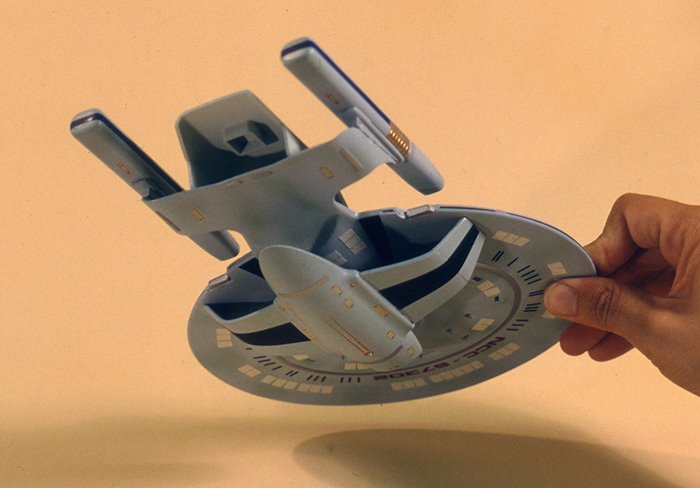
Small things like giant space ships. The Nebula class is that beasty up top there. If you think that looks an awful lot like the Enterprise, that’s because it does. It started life as a kitbash of a normal Enterprise model set for the TNG episode “Best of Both Worlds (Part 2)”. They needed a lot of ships for a scene – a wreckage scene, since a whole fleet of Starfleet ships had been shreked by the Borg. Since there were only so many different kinds of ships that had been made, and since the scene would only be shown for a few moments, and since all the ships would be half-destroyed anyways, this was acceptable. Several other ships were also kitbashes of the Enterprise model – we’ll talk about some of those, too.
Later, the general ship shape was made into the guest-star ship in the episode “The Wounded,” where it was decided that they wanted a spiffy new ship, one that looked like it could be a contemporary of the Enterprise, not one of the old movie ships that the show had been using for the past several seasons. That’s the ship at top, by the way. It’s not just a regular kitbash; even though it uses the same shape as the Enterprise model, the lower section is definitely different. After this, the ship would go on to make several appearances in the various shows, even getting a digital model made for Voyager and DS9 (which was a lot more like the Galaxy-class Enterprise).
Now, the reason I am adding this to the series is that a lot of people assume that it’s an offshoot of the Galaxy class. But I don’t think so, at all. In fact, I think that it’s a precursor to the Galaxy.
The first question, if you think it’s an offshoot of the Galaxy, is why? Why would you have that ship like that? It’s all squished and stuff. “But the pod!” you might exclaim, “that answers everything.” Not really. Why take off the neck, for the pod? And it’s not like they can’t put a pod there, even with the neck – they put another engine nacelle there for the Galaxy: ExTREME Edition, after all.
Also, you have to answer why the ship looks older on the inside. Why does the bridge look so different – so old-fashioned? Why is everything so much tighter? We see three different bridges for this ship, and none of them are the big Galaxy-class bridge.
Nebula Bridge, “Second Sight” DS9
So, my answer is: the Nebula came before the Galaxy. The bridges are older-fashioned because they are actually older. The neck was added to the general design of the Nebula, not the reverse. The pod was to add functionality to an otherwise somewhat lacking design.
So that’s the simple explanation. Now we get to the more complicated (and fun) headcanon. You see, there were a few Enterprise kit-bashes in that Wolf-359 graveyard. But unlike the Nebula, they were more heavily modified, including changing the window size – and thus, the scale of the saucer and the ship. Here are the kitbashes I’m going to be talking about: the Nebula, the New Orleans, the Cheyenne, and the Springfield. (There’s also the Freedom, but it’s ugly and nonsensical, so I don’t care.) As you can see, there are two different nacelle types – one that looks like a pen with a cap on it, and one with the familiar Galaxy nacelles. So, we can posit that they are of at least two different generations of ships. From here on out, I’m just making things up, based on all of the above.
Springfield butt, by Rick Sternbach
In the latter part of the 2200’s, there were several smaller powers that were friendly with the Federation. They would have liked to join, but for one problem: the Klingons. At this point in history the Klingons were about equal in power to the Federation, and highly aggressive; indeed, from about the 2250’s on, there was a state of cold war between the two powers, which almost went hot, save for the intervention of godlike beings. These smaller powers didn’t want to get involved in that mess, so they just stayed friendly. Some of them were technologically similar, or even more advanced, than the Federation, but they were small, sometimes involved just with their home system, so they would be devastated if such a war ever came to them.
However, with the signing of the treaty at Khitomer after the explosion of Praxis, things in that corner of the galaxy cooled down significantly. Additionally, advances in warp drive with the advent of the transwarp drive meant that space, at least Federation space, was quite a bit smaller, in practical terms. Those smaller powers would now be relatively safer as a part of the Federation, rather than standing separately.
Cheyenne Class, by Rich Sternbach
One of those powers was Trill. The Trill had been friendly with the Federation ever since its founding, but never joined up themselves. They did have a thriving starship design program of their own. One of the hallmarks of Trill ships was modularity: often their ships had interchangeable pieces, or places where they could add on modules.
One of those Trill design companies merged with/was absorbed by one of the Federation’s major design teams, Yoyodyne, when Trill joined the Federation. This was the company that designed the famous Constitution-class ships, along with the Miranda and the Constellation. However, a rival firm had designed the Excelsior, which blindsided Yoyodyne, in that it was better at pretty much everything, and had transwarp drive integrated in the very design. With the new Trill ideas, they hoped to come back into the good graces of Starfleet (prestige being at least as valuable as any currency).
The first two designs weren’t flagship material, but covered the roles of attack cruiser and fleet cruiser – the Cheyenne and Springfield, respectively. The Springfield in particular retained the traditional Trill modularity: it had both a top and bottom pod that could be used for various mission parameters. Starfleet wasn’t too hot on either of these designs, but ordered some of both, since it was a time of experimentation and growth.
After a few decades, the Excelsior was getting a bit long in the tooth. Still quite the capable platform, but it wasn’t quite up to flagship snuff. So Starfleet held its usual trial competition – who would get to design and build the new flagship. In the past couple of decades, there had been another leap in warp engine design, so the old stuff just wouldn’t do. Yoyodyne decided to go with what it new – big, ovoid saucer, with a modular focus. To this end, it developed the Nebula. It was significantly larger than the Excelsior, and much faster. It also didn’t have integral torpedo tubes, as this was an exploration vessel, and a vessel of peace. There was a modular pod that could add on any major functionality necessary (including more weapons if needed). Yoyodyne was so confident in this design, that it created a smaller ship, the New Orleans, as a direct replacement to the Excelsior.
New Orleans, by Eaglemoss
However, Starfleet didn’t chose the Nebula as its new flagship class. It was just too radical a departure from the traditional Starfleet template. The new flagship would be the competing Ambassador class. However, the Nebula was indeed a good design, and was put into basically every other job a ship of its size and versatility could handle. The New Orleans, not so much, since the Excelsior was still a very viable platform. But a few New Orleans ships were still ordered – it was a good ship too, just not necessary.
However, the Ambassador turned out to be a bit of a flop. It didn’t have quite the speed or power – or bite – necessary to keep the Federation safe, what with the increasing aggression of minor hostiles like the Tzenkethi and the Cardassians. Yoyodyne was given another chance – the Nebula was good, but too strange and presumptive. If some of the kinks could be ironed out, it would make a great flagship. And so, with a bit of modification (including more spacious areas and a return to the traditional Starfleet ship form), the Galaxy was born. It was still modular – just on the inside, since any internal part could be swapped out without too much fuss.
I think part of the fun of getting into a fictional world of any sort is really getting into that world. I love all the technical details of everything (as long as it’s fun – most harder/”realistic” sci-fi bores me *coughHonorversecough*). Whether it’s actual technical details, like about ships, tech, or magic, or other more esoteric details, like the differences in practice and beliefs of different sects of a religion, or politics, history, or whatever, I dig that. (I never thought the politics/talky portions of the Star Wars Prequels were boring, at least as far as that goes; Lucas’s sins are manifold, but that wasn’t one of them.) I figure a lot of fans are like me, because we keep seeing all these sort of technical manuals and background sourcebooks and whatnot. Star Trek in particular seems to attract that kind of geek.
But there are different levels of these geeks. Some folks just are content to get the basics of how a thing works, just so the various plots make sense (or fail to make sense, when things are inconsistent). Others like to get more into the details of things, even thinking of headcanon to fill in the gaps that the official canon leaves (because no single writer can think of all possible permutations of every situation for every thing in their work). And still others think way too much about stuff, and read too much into things. I’m obviously of the middle, detailed-yet-balanced group.
Why bring that up? Well, today I’m going to be writing about transporters and replicators in Star Trek. In essence, these are magical devices that cheaply help move the plot along, and add a bit of futuristic spice to the franchise universe. One, as suggested by its name, transports things and people to where they need to go, without use of intervening vehicles. The other is a little less obvious by name, though its primary purpose is to magically copy food and drink for the characters, without having to have anyone physically make the food (that takes time and props and maybe even another set for a kitchen and/or dining room, and more actors too). Of course, in-universe this is technology, not magic, but the plot functions are the same.
Of course, as tech it can be explained. And geeks and nerds love explaining stuff like this. Unfortunately, general TV audiences don’t really care too much about how their story devices work, and the vast majority of TV writers are not scientists or engineers, who give a crap about how things work other. A more caring writer, who has inclinations towards making things make sense, though, will at least put in plausible-sounding technobabble, to make the magic make sense. Thus, we hear about things like “Heisenberg Compensators” and “matter streams” and the like. To the fans who like to make explanations, these nuggets are gold.
Unfortunately, some only get to the shallow explanation. Since it is shallow, and most people don’t care to go deep, these shallow explanations can spread around fandom, and become the “accepted” explanation. In the case of replicators and transporters, it has become the “accepted” explanation that these things convert matter to energy, and/or vice versa.
To me, this is a very shallow look at how these techs work. The idea comes from one time that some character said something about how the transporter turns matter to energy and back again; and for replicators, how Voyager had to ration replicator use because of energy concerns. This is shallow, because it’s a valid explanation, but doesn’t go into any detail, or look at any contradictions (and with about a zillion episodes of television, there are going to be contradictions).
I think that the first thing that is wrong is that matter-energy is being converted at all. This doesn’t seem to be the actual case. Let’s start with replicators, because it seems that it only goes one way (it actually doesn’t – at least once characters talk about returning dirty dishes to the replicator, which means the process is reversible). If things were merely made up out of whole cloth (from pure energy), just how much energy would be needed? Well, let’s assume you have a 1kg meal set (which includes all the dishes needed for the meal), since that’s easy for calculations. Energy-matter conversion is a simple equation E=mc^2, where the energy will be in Joules (J). With 1kg of matter, that comes out to 89.9 billion-million J. That’s a lot. Like, seriously, a lot. If all that were to come out in an explosion, it would be the equivalent of 21.48 megatons of TNT. To put that into perspective, the most powerful nuclear device ever detonated by the United States was ‘only’ 15 megatons. (This makes sense: the way nuclear weapons work is that the nuclear reactions convert matter to energy; that 15 MT device (“Castle Bravo”) converted about .7kg of it’s 10,700kg total mass into energy.)
Is it realistic to think that this much energy is flying through the ship (or home! because normal citizens on planets have replicators in their house) every time someone wants some din-dins? We know that Star Trek ships have some…problems with their energy systems, and exploding in red-shirts’ faces. But that’s on the order of hand grenades, not nukes.
Plus, to get that much power, they need some power source. And the only way to reliably get that much power is with an matter-antimatter reactor, which converts mass (matter and antimatter) into energy. Fortunately, this is how a Trek ship generally gets its power. However, that power comes at the use of fuel. To get that 1kg meal, you’d need 1/2kg of matter and 1/2kg of antimatter. At least, because that assumes 100% efficiency, and as far as we know, Trek tech hasn’t learned quite how to violate the 2nd Law of Thermodynamics. That’s fuel that going directly into making your massive pile of tendies, and not twisting the laws of physics every which way to move you several hundred times the speed of light, without any inconvenient relativity effects.
So, if not that, then what? Well, there are other hints. The sfx used for the replicators is very similar to the sfx used for transporters. Also, we know that certain things cannot be replicated – living things, sufficiently complicated stuff, gold-pressed latinum, and so on. So…what if the replicator is merely a small transporter? But, you ask, how does the replicator get all its meals? Is there still a galley, making whatever could possibly be asked for?
No. What a replicator is doing is taking from stores of other substances, and then making it into whatever you ask. These things have to be programmed, so it’s not like it can make anything (thus, the ‘replicator’). And you have to already have the base substances, so you can’t just magic up some latinum and be rich instantly (and/or crash the galactic economy) – you have to have latinum already in the replicator storage pool. And, since most of what is made with replicators is food…where can you get extra matter for food? That’s right: the toilet! That’s just used food, so it’s cool. Rearrange all the atoms in poopoopeepee, and you get food, and no longer the nasty stuff. Simple, easy recycling: good on a spaceship.
But what about the high energy costs, as per Voyager? Well, I think we can guess that transporters take a lot of energy, and if replicators are mini-transporters, they will also use a lot of energy. A ship, especially one traveling nearly constantly in a cruising state, won’t be using its transporters a lot. But replicators would be used every time someone gets a bit peckish, which in a crew of 75 or so, would be hundreds of times a day (especially those Bolians.) That could be quite a bit of energy used. And I don’t know if it was because of fuel concerns specifically; I’m not sure it was specifically stated to be so, or if you could headcanon it to be that the constant use of the energy system by replicators would wear them out: not a problem in friendly space, or anywhere near friendly space, where you could get spare parts, but definitely a problem when you’re decades from home; at any rate, it stops being a thing by the third or fourth season, so whatever.
So, how about that transporter then? Is it converting people and things to energy, then back to matter again? I don’t think so. Like I said above, this may have been explicitly stated at one point, but the idea is contradicted several times. First, there is the mention of a ‘matter stream’. What would a matter stream be but…matter? Second, you still have that problem of having tons and tons of energy moving about. What happens when the transporter fails to turn someone back to matter, and all that energy (50-150 times the energy of that 1kg meal) gets released on the transporter pad, or in that park? We already know that transporters are not 100% reliable – these things mess up often enough that scaredycats like Barkley use them as little as possible (probably like a .00001% failure rate – but do you want to be that person that becomes a blob being for a few seconds while dying an excruciating death?).
And, if it were so, you would have no problems with energy or weapons. Why use torpedoes when you can just beam some energy (former matter) into or near the opposing ships? Boarding parties got you down? Just beam them back to their own ships, but forget to make them back into matter – it’s only a 1-2 gigaton boom. Why keep specialized fuel when you can just do the same to your own generator (just not a whole person…hopefully). Since they never do this, and they do have fuel for their ships (antimatter fuel specifically, and supposedly the opposed matter for it), and that this particular issue never even comes up as a possibility of failure, seems to suggest that the transporter does not turn you into energy to hurl you through the aether.
So what then? Well, let’s go look back at that ‘matter stream’ thing. The transporter has been described as something along the lines of “tearing all your particles apart, throwing them across space, and then putting them back together again”. I don’t know if such a thing has ever been said on the show, but it’s certainly the idea of the transporter. So, why add a bunch of matter-energy stuff to that? Just because it sounds more sciencey and impressive? You know what sounds even more impressive? Saying the transporter squishes and tears you into a bazillion pieces, moves you through 16-dimensional space, and then makes you come back together again, just as it found you (not really, because it takes your diseases out (sometimes), turns on the safety for your gun, etc., but close enough for space-government work). And it does it at a distance, not needing the actual physical transporter device to be anywhere near you at either end (I figure the transporter pad has to be somewhere in the 16-dimensional path, though; otherwise, why have it in the first place?).
A final aside: the transporter, contrary to the comic at the top, actually proves you don’t die, and that you have a soul, of sorts. This may seem weird, since Star Trek is supposed to be this materialist humanist utopia, without a religion in sight (at least on Earth). Well, that’s another one of those shallow explanations. If you have gods and energy beings and telepaths and espers and all that, why not souls? And one episode of DS9 proved that there are indeed souls, again, of a sort. In the episode “Our Man Bashir,” most of the main cast is involved in a transporter accident, which leaves the ‘putting-together’ part of the transporter inoperable. But our heroes are fine, since the data needed to put them back together is stored in the computer. Well, sorta, since I guess it’s kinda like RAM, and it only saves just long enough to get used, or something like that, so the patterns have to be saved in other parts of the station’s computers, including the holodeck. The relevant thing here is that the neural patterns and the physical patterns are separate.
Now, if you were a materialist, you’d say that one’s neural patterns would just be based on chemical and physical reactions in the brain; these ‘neural patterns’ are just merely a part of the physical pattern. But that’s obviously not the case here. In fact, the holodeck computer could only hold the physical pattern (which involved all the processes of life – which are apparently too complicated for a replicator to recreate, mind). Which means the neural patterns are waaaaay more complicated than all the quantum stuff involved in a person’s body. But if your neural patterns are merely part of your physical body, they can’t, by definition, be more complicated than the body, since they are merely a part of the complication. Thus, those neural patterns are something else entirely. One could very well call that the soul. (Though it’s obvious that it’s not a Christian understanding of the concept (such as there is a particular ‘Christian’ understanding of the soul), so that’s fine for fedora-tippers like Roddenberry and friends.) This goes along with the idea of the Katra: the Vulcan soul, which can apparently be stored in jars.







 Dating Sims on the Holodeck